Apostille and document legalisation
The single most common reason a Korean visa application stalls has nothing to do with whether you qualify. It is that a document from your own country arrived without the stamp that makes it foreign-usable.
The problem this solves
A Korean immigration officer holding your university degree certificate has no way to know whether it is real. They cannot recognise the seal, they have no register to check it against, and the institution that issued it is on the other side of the world. The same is true of your birth certificate, your marriage certificate and your national police check.
Legalisation is the machinery that fixes this. It attaches, to your document, a certificate from an authority that Korea does recognise, saying the signature and seal on the underlying document are genuine. Korea then trusts the chain rather than the document.
Two things follow from that framing, and both catch people out. First, legalisation says nothing about whether the contents are true — it authenticates the signature, not the claim, which is why a legalised document can still be questioned on its substance. Second, it is done in the country that issued the document. You cannot walk into an office in Seoul and have a British degree certificate legalised there.
Apostille or consular legalisation
Which route applies to you depends on one thing: whether the issuing country is a party to the Hague Convention abolishing the requirement of legalisation for foreign public documents. Korea has been a party since 2007.
| Apostille | Consular legalisation | |
|---|---|---|
| Applies when | Both countries are parties to the Hague Convention | The issuing country is not a party |
| Steps | One — the designated authority in the issuing country | Three — notary, then that country's foreign ministry, then the Korean embassy there |
| Result | A standard-format certificate attached to the document | A Korean consular stamp on the document |
| Typical time | Days to a few weeks | Weeks to months |
Membership changes. Countries join, and when they do the process for their documents switches from the three-step consular chain to a single apostille — Canada, for instance, became a party relatively recently, and guidance written before that is now wrong. Check your country's current status with the Hague Conference or with the Korean embassy that covers it before following any instructions you find online, including instructions that were correct when they were written.
Who issues an apostille
Each member country designates its own competent authorities, and there is no universal rule. Some patterns:
- A foreign ministry or its legalisation office handles it in most of Europe. In the United Kingdom this is the Foreign, Commonwealth and Development Office.
- A federal system may split the authority. In the United States, state-issued documents such as birth and marriage certificates are apostilled by that state's Secretary of State, while federally issued documents — most importantly the FBI Identity History Summary — go to the US Department of State. Sending a federal document to a state office is a wasted month.
- Courts or justice ministries handle it elsewhere, sometimes with different authorities for different document types within the same country.
The practical rule: identify the correct competent authority for that specific document, not for your country in general. This one distinction accounts for a large share of rejected paperwork.
Which of your documents need it
Not everything does. As a working guide for the applications this site covers:
- Degree certificates and transcripts — required for E-2, E-7, D-2 admission, and for the education points on the F-2-7 table.
- National criminal record checks — required for E-2 and for F-6. This must be the national authority's check, never a state, provincial or local police report, and it must be apostilled by the authority that matches that issuer.
- Birth and marriage certificates — for F-6, for F-4 descent evidence, and for dependant applications.
- Professional licences and career certificates — where an E-7 occupation code is being met through experience rather than a degree.
Documents issued in Korea — your residence card, a Korean employment certificate, a Korean tax document — never need this. They are already domestic documents as far as immigration is concerned.
Translation
Legalisation and translation are separate requirements, and satisfying one does not satisfy the other. A document in English is generally accepted by Korean immigration alongside its apostille. A document in any other language usually needs a Korean translation as well.
Where a translation is required, the office will normally want it certified — either by a translator whose credentials are attached, or notarised in Korea. Getting a document translated before it is apostilled is a common misstep: the apostille attaches to the original public document, and a translation is not one. Apostille first, translate second.
The clock, and why it decides your order of operations
Almost every document in this process carries a validity window. Korean offices commonly want certificates issued within the last three months, and criminal record checks within six. The apostille does not restart that clock — validity runs from the underlying document's issue date, not from the date it was authenticated.
That single fact determines the correct sequence, and getting it backwards is how people end up doing the whole thing twice:
- Start the slowest document first. National criminal record checks take six to twelve weeks in many countries before the apostille is even applied for. Begin here, always.
- Order documents that never expire next. A degree certificate is a fact about the past; it is not going to become stale. Get it apostilled early and keep it.
- Order the short-life documents last, timed so they are as fresh as possible when the application is submitted. A civil status certificate obtained too eagerly can expire while you wait for the police check.
- Submit as a complete set. Korean offices assess a file, not a stream of arrivals.
If you are applying from inside Korea — a change of status rather than a new visa — you are dependent on family abroad or a courier for every one of these steps, which adds weeks. Start earlier than you think you need to.
What goes wrong
- The wrong level of authority. A local police certificate instead of the national one. A university registrar's letter instead of the degree certificate. These are rejected outright rather than queried.
- An apostille from an authority that does not cover that document type. Common in federal countries, and the error is only discovered at the Korean end.
- A photocopy sent for apostille. Most authorities certify originals or officially issued certified copies, not your own copy of one.
- Staples and seals removed. The apostille is physically attached for a reason. Do not detach, re-staple, laminate or trim anything.
- A name mismatch. If your degree is in a maiden name and your passport is not, you need the document that connects them, legalised too.
- Assuming a scan is enough. Korean offices generally want the physical document with the physical apostille. Some accept electronic apostilles where the issuing country offers verifiable ones; confirm before relying on it.
Doing it from Korea
If you are already here, two facilities help. Your own country's embassy in Seoul can often issue or certify certain documents locally — the range varies enormously by country, so ask rather than assume. And Korean documents you need to send abroad are apostilled by the Ministry of Foreign Affairs, which runs a consular service counter for exactly this, so the traffic runs in both directions.
For Korean documents there is also an online route. The Ministry of Foreign Affairs runs an e-Apostille service at apostille.go.kr, in English, which issues an apostille immediately and without a fee for a defined list of documents. It is worth looking at even if you do not need it yet, because the way it is organised makes the rule above concrete: you choose the authority that issued your document first, and the document types follow from that choice.
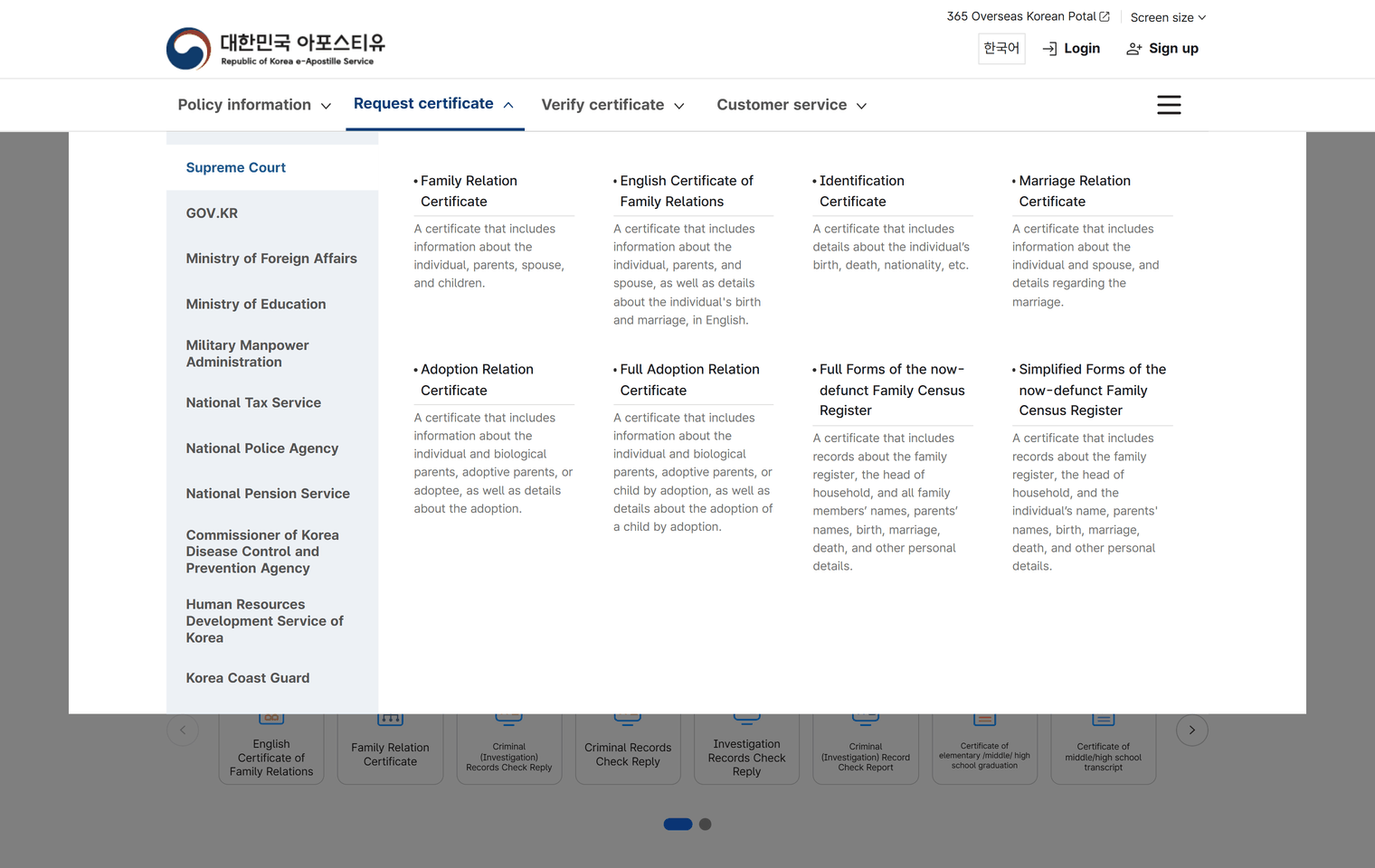
Two limits on the online route. It covers Korean public documents only, so it does nothing for the degree certificate or police check you need from home; and only documents held electronically by those authorities are on it, which is why a paper certificate issued years ago may still have to go to a counter. Note also the English Certificate of Family Relations in that list — where an English version of a Korean record exists, requesting it directly saves you a certified translation later.
For anything that must be obtained in your home country, budget for courier costs and for the possibility of a second attempt. The cheapest way to do this is slowly and once.
Not legal advice
General information only. Competent authorities, convention membership and validity windows differ by country and are revised without notice, and the office assessing your application has the final word on what it will accept. Confirm the current requirement with the Korean embassy or consulate covering the issuing country, with the Ministry of Foreign Affairs consular service at 0404.go.kr, and with HiKorea or the 1345 Immigration Contact Center.