Korean address in English
Paste a Korean address and get the official English form — in the order couriers expect, with the road suffixes written the way the road-name address standard requires.
The rules this follows
Korea replaced its lot-number address system with road names in 2014. The new system has an official romanization standard, and it is not quite the same as ordinary Revised Romanization — which is why so many online converters produce addresses that a Korean postal worker would find odd.
Order is reversed
A Korean address is written largest unit first: province, city, district, road, building number. English addresses run the other way. The conversion is not a translation so much as a re-ordering, and getting it backwards is the single most common mistake on international shipping forms.
Road suffixes are hyphenated and never translated
| Korean | English | What it means | Example |
|---|---|---|---|
| 대로 | -daero | Boulevard — eight lanes or more | 세종대로 → Sejong-daero |
| 로 | -ro | Road — two to seven lanes | 테헤란로 → Teheran-ro |
| 길 | -gil | Street — smaller than a 로 | 판교로 22길 → Pangyo-ro 22-gil |
| 시 | -si | City | 성남시 → Seongnam-si |
| 군 | -gun | County | 양평군 → Yangpyeong-gun |
| 구 | -gu | District within a city | 강남구 → Gangnam-gu |
| 읍 / 면 | -eup / -myeon | Town / township | 진접읍 → Jinjeop-eup |
| 동 / 리 | -dong / -ri | Neighbourhood / village | 역삼동 → Yeoksam-dong |
| 도 | -do | Province | 경기도 → Gyeonggi-do |
Note that -ro keeps its spelling even when Korean pronunciation would change it. 종로 is
pronounced closer to "Jongno", but the road-name standard writes it Jong-ro, because the
suffix is treated as a separate unit across the hyphen. Converters that apply ordinary romanization rules
get this wrong. This one does not.
Provinces and metropolitan cities have fixed spellings
Seoul is Seoul, not "Seoul-si" and certainly not "Seoul Teukbyeolsi". Busan, Daegu, Incheon,
Gwangju, Daejeon and Ulsan are written plainly. Sejong takes -si. The nine provinces take
-do: Gyeonggi-do, Gangwon-do, Chungcheongbuk-do, Chungcheongnam-do, Jeollabuk-do,
Jeollanam-do, Gyeongsangbuk-do, Gyeongsangnam-do and Jeju-do.
Checking this against the government's own tool
You do not have to take my word for any of it. The Ministry of the Interior and Safety runs the address register itself at juso.go.kr, and it will print the registered English form of any address on request. Search the Korean address, then use the 국문 / 영문 toggle on the result to switch it into English.
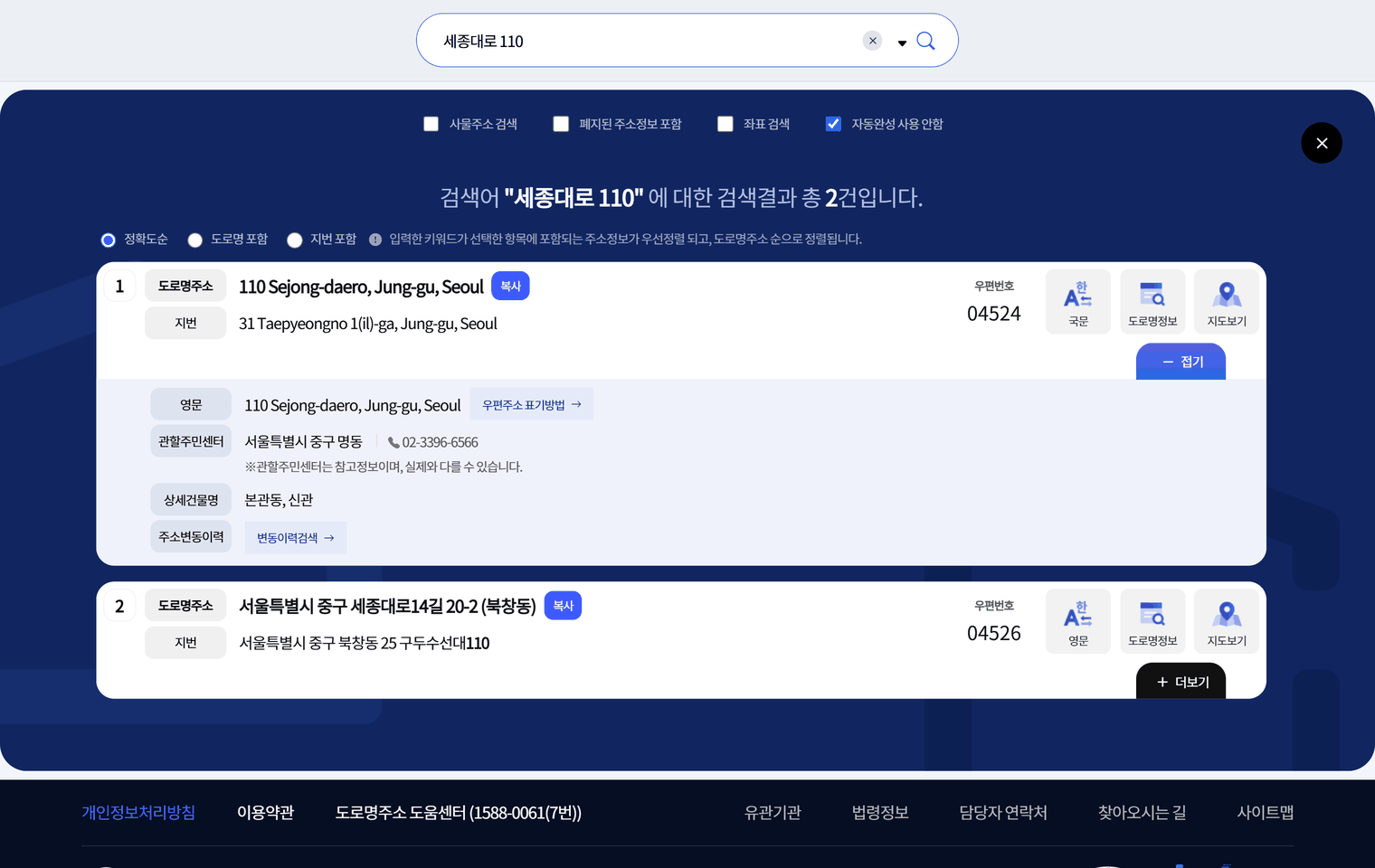
-gu, and the five-digit postal code
04524. Put the same address into the converter above and you should get the same line back.
Note the second result: the lot-number address Taepyeongno 1(il)-ga is romanized by pronunciation
where the road name is not, which is the distinction the table above is about.
Screen captured 27 August 2026. Source: 주소정보누리집 (juso.go.kr), Ministry of the Interior and Safety.
Two caveats on using it as a cross-check. It answers for addresses that exist in the register, so a new building or a recently renamed road can lag; and it romanizes the lot-number (지번) form by pronunciation while leaving the road name alone, so the two lines in a single result are not produced by the same rule. Where this converter and the register disagree on a road name, the register is right and I want to hear about it — that is what the corrections log is for.
Filling in a Western checkout form
Foreign shopping sites almost never have a field layout that matches a Korean address. The mapping that works reliably:
- Address line 1 — building number, then the road name.
152, Teheran-ro - Address line 2 — building name, floor and unit, if any.
- City — the
-gudistrict for the six metropolitan cities and Seoul; the-sicity elsewhere. - State / Province — the metropolitan city name, or the
-doprovince. - ZIP / Postal code — the five-digit code. Never the old six-digit one.
- Country — South Korea, country code KR.
If a form insists on a state from a fixed dropdown and Korea is not in it, put the metropolitan city or province in the city field and leave the state blank. Korean postal routing works off the postal code.
Common questions
My address is the old lot-number kind (지번주소). Will this work?
Partially. The converter romanizes what it can and warns you that no road name was found. Lot-number addresses are still legally valid but couriers increasingly struggle with them. Look up the road-name equivalent at juso.go.kr, which has an English interface, and use that instead.
Do I need the dong (neighbourhood) name?
No. Under the road-name system the road plus the building number uniquely identifies the address, and the dong is redundant. It is often printed in brackets for familiarity. Including it does no harm; omitting it does none either.
Should I write the address in Hangul or English on an incoming parcel?
Both, if the form allows it. The international leg is routed on the country and postal code, and the domestic leg is delivered by a Korean courier who reads Hangul far faster than romanized text. Putting the Hangul in the second address line is the pragmatic answer.
Is my address sent anywhere?
No. The conversion runs entirely in your browser using a romanization engine built into this page. Nothing is transmitted, logged or stored. The optional official lookup is the one exception, and it is disabled unless the deployment has been configured with an API key.
About accuracy
This converter implements the published romanization rules faithfully, but a small number of place names have officially registered English spellings that depart from the rules for historical reasons. For legal documents, and for anything where an exact match to a government record matters, confirm the address at the Korean address information system, which publishes the registered English form.